Essex County and the Lens of Memory

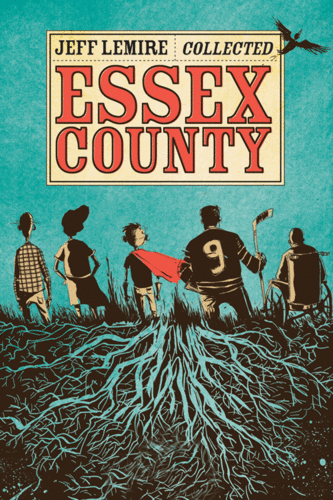
Essex County by Jeff Lemire

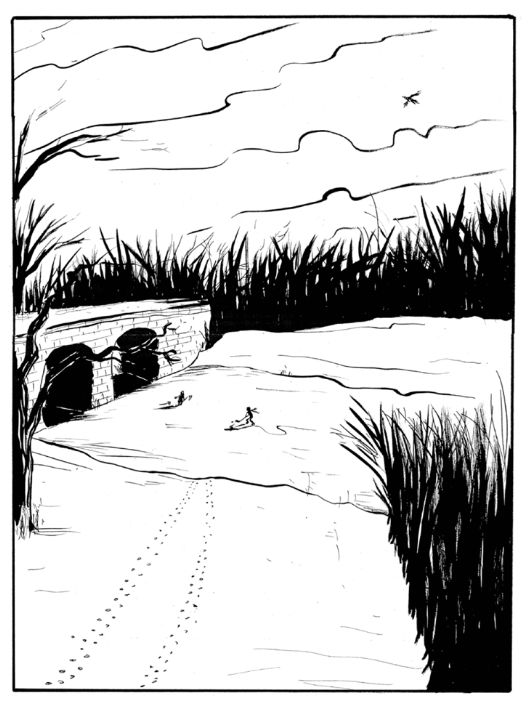
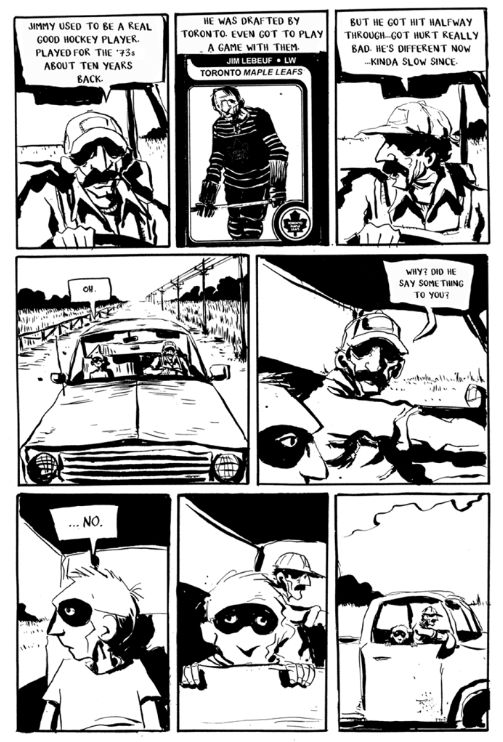
After stumbling upon Jeff Lemire’s “The Underwater Welder”, I then sought out Essex County”, his widely praised 2009 graphic novel about life across several generations in a small county in rural Ontario.  Wow!  What a masterfully written (and drawn) elegy about the power and frailties of memory and personal connections.  Highly recommended.

Essex County -- Jimmy Used To Be A Good Hockey Player

* * *

Essex County -- I've Been Here Before

* * *

Essex County -- Playing Hockey

“Wolf Pavilion” by Michael Adamson

Michael Adamson, "Wolf Pavilion" (2012) Oil on Canvas

Michael Adamson, “Wolf Pavilion” (2012) Oil on Canvas

While the shock of vibrant orange draws me in, what I like most about this vivid painting by Michael Adamson is that there is so much going on in it.   An exhibition of some recent works by this Toronto-born artist opens in May in that city’s Moore Gallery.

The Underwater Welder by Jeff Lemire

The Underwater Welder

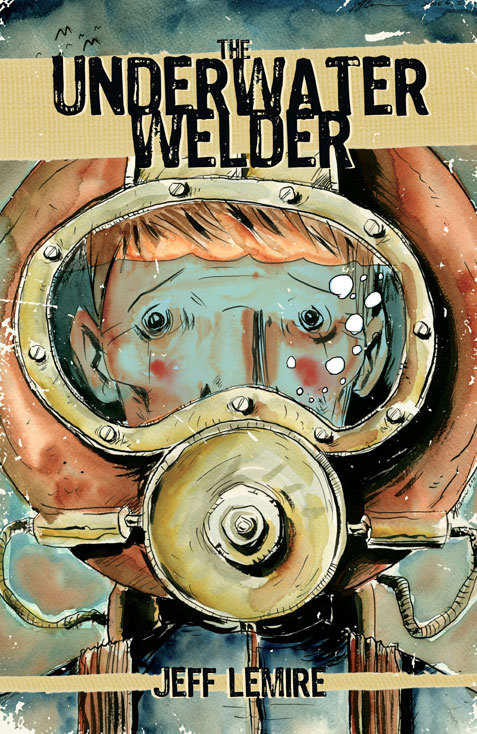
As I’ve recently mentioned, I’ve been checking out what’s worth reading when it comes to Canadian graphic novels.  As part of that winding exploration,  I stumbled across Jeff Lemire’s The Underwater Welder, which was published in 2012 by  Top Shelf Productions (right here in Atlanta).  Lemire, who lives in Toronto, is an award-winning writer and illustrator whose previous works include the highly acclaimed  Essex County and Sweet Tooth.

Jackie-.-.-.

Through the fascinating story told between these covers, Lemire showcases the best in the literary graphic novel form.  The Underwater Welder offers a glimpse of Jack Joseph, an oil rig welder in Nova Scotia, and his search for meaning in his life as he and his wife await the birth of their first child and he struggles with ambivalent memories of his father, who died years earlier in a diving accident off the nearby shore.   With masterful storytelling complemented by his creative graphics — drawn from many vantage points and skillfully using flashbacks,  scene blurring and other innovative techniques — Lemire touches eloquently upon the themes of memory, loss, parent-child bonds, relationships, love and purpose.

Time-to-Wake-Up

In an introduction for the book, noted television writer and producer, Damon Lindelof (Lost, Star Trek, etc.), likens Lemire’s story to an episode of The Twilight Zone and that is certainly one way of approaching this well executed tale.  However, unlike with what might be expected of a typical Twilight Zone sketch, the ending in The Underwater Welder is not discordant but instead signals a note of grace.   Lindelof’s praise for Lemire includes this amusing, good-natured observation:  “I am deeply threatened by Jeff’s creativity, a fact mitigated only partially by the fact that he is Canadian and thus, inherently non-threatening.”

More information on The Underwater Welder, Lemire and his other outstanding works can be found on his blog here.

Back-to-Rig-1

Another Favorite Publisher: Firefly Books

Firefly Books Logo

Not long ago I commented on the remarkable Canadian publisher Douglas & McIntyre.   Another nifty Canadian publisher worth taking note of is Firefly Books, which emphasizes non-fiction.  Aside from McClelland & Stewart, a major Canadian publisher that is a division of Random House, it seems that when it comes to high quality books from Canada one of these two outfits is sure to have had a hand in such works.  While Richmond Hill, Ontario-based Firefly produces a high number of science, nature and “how to” type books, the titles that stand out for me are those focused on art and photography.  Their volumes in those two areas are among the best on their subject matters.

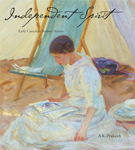
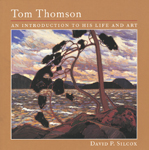
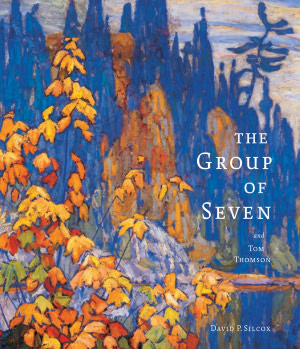
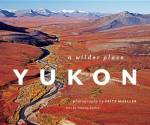
Pictured above is a random selection from the Firefly catalog.  Coincidentally, I have four of these and each is very well done for its subject matter.   Of these, David Silcox’s The Group of Seven and Tom Thomson, is the subject of an earlier post here, and I plan to comment on Pat & Baiba Morrow’s The Yukon and George Walker’s Graphic Witness — each mesmerizing in its own way — in the next few weeks.

Although it’s generally not fair to judge a book by its cover, the graphic elements of book design can play a role in pulling in a prospective reader.  So it’s a minor complaint that the website for Firefly Books, unfortunately, does not do its catalog justice in this respect.  When searching for a book a listing of titles is initially displayed and one must click on the title to get more information and only then get a visual on a given title.  Of course, this is a non issue once you’ve located the book for which you were searching or already have it in your hands

Canada at War: A Graphic History of WWII

Canada At War

I’ve long been a fan of graphic novels as both an art form and literary form.  Over the past decade, it seems that graphic novels as a genre have come into their own and are no longer dismissively regarded as just comics for grownups.  I like them as much for the elements of creativity that a well done volume can bring to telling a story as well as for their being excellent reflections of the adage that a picture is worth a thousand words.  So a couple of weeks ago my curiosity sent me in search of graphic novels either about Canada or by Canadian authors.  Unsurprisingly, given the many other contributions of Canadians to the culture of popular entertainment, there appear to be a fair number of such graphic novels.  In particular, Canada boasts the quite prolific graphic artists Seth (a/k/a Gregory Gallant), who has released several acclaimed graphic novels in recent years, including It’s A Good Life If You Don’t Weaken (1996), George Sprott (2009) and The Great Northern Brotherhood of Canadian Cartoonists (2011), and Scott Chantler, whose works include Northwest Passage (2005-2006) and Two Generals (2011).

I’m still exploring the Canadian graphic novel, so for now I’ll share a few thoughts on Canada At War:  A Graphic History of World War Two, written by Paul Keery and illustrated by Michael Wyatt, which was published in 2012 by Douglas & McIntyre publishers and which I just finished.  This non-fiction graphic novel provides quite an eye opener about how WWII greatly contributed to the maturing of Canada’s armed forces and the national identity.  It also helped me to understand better the circumstances that gave rise to the disastrous battle at Dieppe in 1942, one of the more tragic episodes involving the Canadian military and which I had heard mention of before but had not fully appreciated.  Among other things, Keery provides an overview of the role of each branch of Canada’s armed forces and major battles or efforts in the Atlantic, the Pacific, in Europe, in Asia and at home. There are numerous vignettes throughout the book highlighting daring acts of bravery and heroism as well as facets of the country’s war effort that remain well below the radar screen but which were, nevertheless, vitally important to the eventual success of the Allied forces.  Keery’s graceful writing and Wyatt’s riveting illustrations are well paired here.  Highly recommended reading.

Update:  Since posting the above, I discovered that Keery and Wyatt have a site devoted to Canada At War, which makes for great additional reading, especially their thoughts on the creative process and their preference in referring to the book as a graphic history as opposed to a graphic novel.  Their site is here and contains additional excerpts.

Jerry Kobalenko’s Beautifully Rendered Arctic Eden

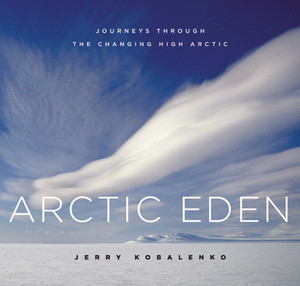
Arctic Eden

In light of the major blizzard that struck the northeastern U.S. yesterday and the deep freeze that settled over much of eastern Canada a couple of weeks ago,  I thought I’d continue with the winter theme of some of my recent posts (see Retro Winter Travel and Recreation Ads and “Ice Break” by Astrid Blodgett) by sharing my praise for Jerry Kobalenko’s Arctic Eden:  Journeys Through the Changing High Arctic.  Although it first caught my eye over a year ago and has been sitting on one of my shelves awaiting my attention since then, perhaps because this wintry season’s colder than usual weather had set the right mood,  I finally got around to reading it this past week.

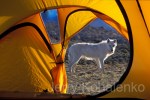
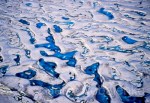
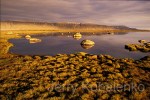
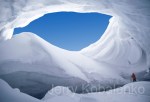
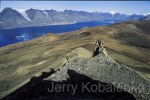
Arctic Eden is part travelogue (or better put, adventurelogue), part historical overview of explorations of the High Arctic region of Canada, but mostly it is a beautiful  showcase of Kobalenko’s exquisite photography of the stark and at times haunting landscapes of the rugged northernmost latitudes of Canada.  Through the book Kobalenko, who is based in Alberta, narrates for his readers several sled-pulling treks through the extremities of Nunavut, including Devon Island, Axel Heiberg Island and Ellesmere Island, and he does it in such a way that one can readily visualize the experience of which he writes.

The text is nicely complemented by asides about early Arctic adventurers and local flora and fauna and the author’s stunning images that demonstrate his keen eye for the beauty of this harsh environment.   While shades of white and blue dominate the landscape, I was struck by the much wider range of vivid colors than I expected in these images of the Arctic.  What comes across most clearly is Kobalenko’s good-natured passion for outdoor adventure and his joyful appreciation for each visit to the High Arctic that he’s been privileged to make (apparently through much resourcefulness on his part).  I should also note that in several places he acknowledges his wife, Alexandra, as his steadfast companion in adventure and in preparing key parts of the book.  Undoubtedly, this thankful sensibility contributed to Arctic Eden’s receipt of the 2012 William Mills Prize for Non-Fiction with a polar theme.

I’ve posted above a handful of Kobalenko’s photos from the book, more of which can be viewed on his website (www.kobalenko.com).  His website, by the way, is quite nicely laid out and has information on ordering this and his other books as well as his photos.

Photo Credits:  Jerry Kobalenko

Retro Winter Recreation and Travel Ads

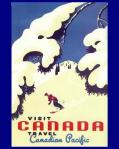
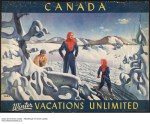
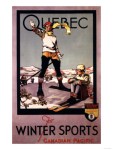
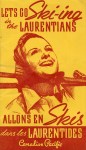
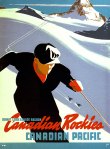
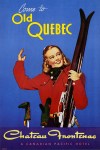
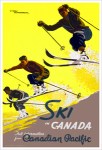
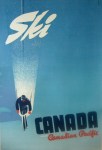
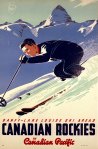
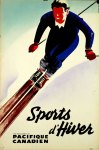
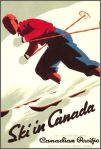
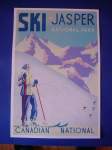
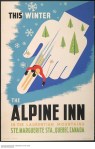
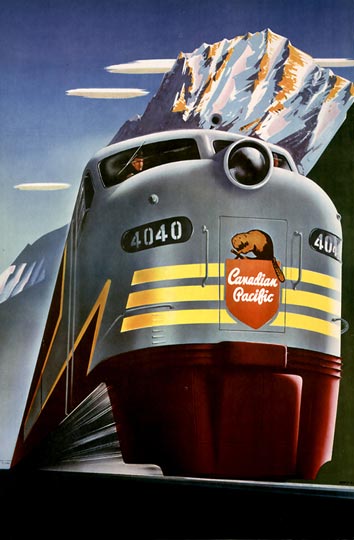
Temperatures this far south, as well as the extreme cold gripping much of eastern Canada this week, leave no doubt that we’re deep in the heart of winter.  Because of this, my thoughts turn toward skiing, ice skating, hockey and other winter recreations and the many places above the 49th parallel — among them Banff, Quebec, Whistler, the Laurentians and Jasper — that are popular destinations for cold weather and snowy pastimes.  So, I thought I’d share some retro travel ads and posters touting these places and this season’s activities.  Many of these are from the Canadian Pacific Railway, which engaged in  a wide range of travel promotions for locations throughout Canada (and beyond).  The vivid graphics work their magic by conveying visions of boundless wintry pleasures.  Among the more distinctive of these works are those by Peter Ewart and Roger Couillard, two of the more notable artists commissioned for their attractive illustrations.  More Canadian Pacific travel posters may be seen here on an earlier O’Canada Blog post.

Image Credits:  Library and Archives Canada; Canadian Pacific Railway Archives

Douglas & McIntyre: An Exceptional Indy Publisher

Although several volumes produced by the Vancouver-based Douglas & McIntyre have sat upon my shelves for quite awhile,   I had not focused on this independent publishing powerhouse until I recently posted some thoughts about art in the Pacific Northwest and pondered the coincidence that two art books (Shore, Forest and Beyond and Mythic Beings) mentioned then were from D&M.  I also count Inuksuit (noted in O’Canada Blog on January 31, 2011) and Arctic Eden  among my books from D&M that contain beautiful images of special aspects of the Canadian physical and cultural landscape.

Exploring their catalog of titles, what strikes me are the diverse range and high quality — there are many award wimmers here — of Douglas & McIntyre’s art-themed volumes and its literary fiction and non-fiction.   Its affiliated imprint, Greystone Books, is also quite good.  I’ve added several to my wish list.   Some of the titles that stood out from my browsing include those below.

First Nations Art of the Pacific Northwest

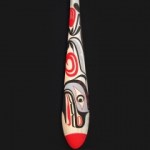
During a trip to Vancouver last December with my two sons, we visited the Vancouver Art Gallery’s outstanding exhibition “Shore, Forest and Beyond: Art from the Audain Collection”.  What a spectacular display of traditional and contemporary artworks related to British Columbia!  The Vancouver Art Gallery and Douglas & McIntyre Publishers (more on them in a later post) collaborated on a book, Shore, Forest and Beyond, showcasing the exhibition that is well worth obtaining.  On that visit, I also brought back a copy of Gary Wyatt’s beautiful book, Mythic Beings: Spirit Art of the Northwest Coast (also published by Douglas & McIntyre).  While there’s much that can be said about the show and several of the commercial art galleries in that region that focus on such artists, for now it prompts me to share some contemporary art with traditional motifs from the first nations tribes of the Pacific Northwest and a few of the galleries where such works can be found.

Selected Art Galleries:

Ahtsik Native Art Gallery, Port Alberni, BC

Spirit Wrestler Gallery, Vancouver, BC

The Path Gallery, Whistler, BC

Coastal Peoples Fine Arts, Vancouver, BC

Black Tusk Gallery, Whistler, BC

I-Hos Gallery, Courtenay, BC

Inuit Gallery of Vancouver, Vancouver, BC

Spirit of the West Coast Art Gallery, Courtenay, BC

Amazing Landscape Artistry of Philip Buytendorp, Jennifer Woodburn and Steve Coffey

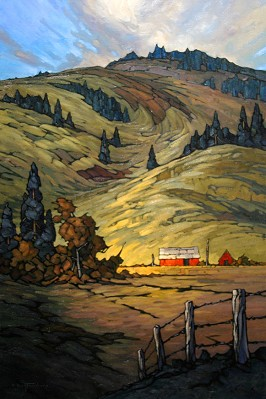
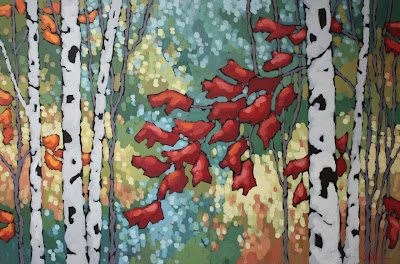
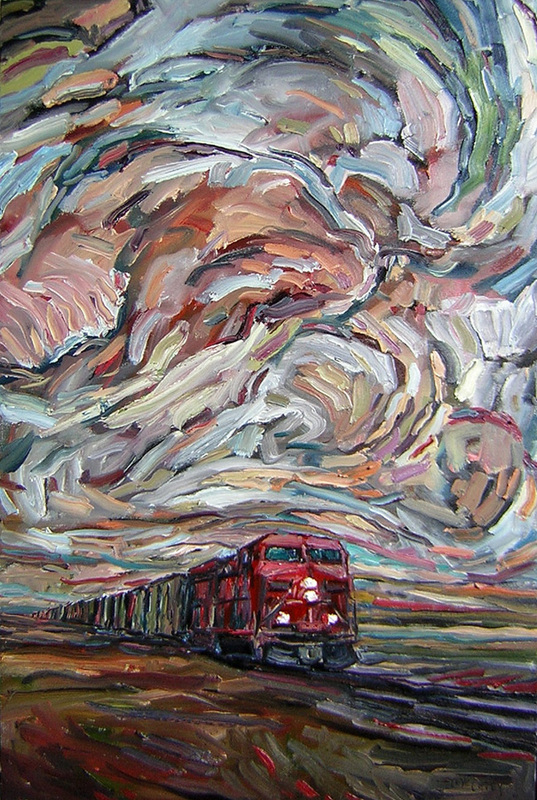
Browsing at a local Barnes & Noble the other night I came across the Fall 2012 issue of Arabella , a Canadian arts quarterly.  Standing out within the 400 or so glossy pages were the works of Philip BuytendorpSteve Coffey and Jennifer Woodburn, three amazing landscape artists each painting in a decidedly impressionistic style that for me harkens back to the talented Group of Eight.   Buytendorp’s canvases  convey an aesthetic and color palette that is highly reminiscent of Tom Thomson’s vivid Canadian landscapes, while Woodburn’s style has a beautifully dreamy appeal and Coffey’s mannerism is soulful.   Nice profile writing by Kylie Serebrin on two of these artists.

Sites / links for more info on these artists and their galleries:   Philip Buytendorp * * Jennifer Woodburn * * Steve Coffey

“Things” by John Heward at Atlanta Contemporary Art Center

Attended an interesting discussion at the Atlanta Contemporary Art Center (ACAC) today that included the inter-disciplinary Montreal artist, John Heward, and Portland, Oregon-based Jessica Jackson Hutchins, who principally works with mixed media and assemblage sculpture.  An exhibition of works by both these intriguing artists opened at ACAC last night and for which the opening reception was graciously supported by the Consulate General of Canada in Atlanta.  Heward and Hutchins shared insights about inspiration for their pieces and the ideas that are exploring in their work.  In many ways, Heward’s work appears to be very site specific, at least that is true of the mysterious draped and painted rayon swaths that adorned the ACAC gallery devoted to his work in this exhibition.

More on Heward (and Hutchins) can be found at http://www.thecontemporary.org/exhibitions/john-heward/#.

Ottawa in 30,000 Frames!

Given the most recent post about Ottawa, this seems as good a time as any to share a cool video tribute to that fair city that I came across several months ago while searching on Vimeo.  This is by Will Cyr, a former resident of Ottawa, and it’s amazing the way Cyr has captured the essence of the place so creatively and diligently — frame by painstaking frame.  Hope you enjoy . . .

Cirque’s “Ovo” Opens


Last night my wife and I attended, along with a group of  ten or so with connections to Canada, the preview / dress rehearsal of Cirque du Soleil’s “Ovo,” which opens its regular shows in Atlanta today.  As with so many Cirque shows, the insect-themed “Ovo” features incredible acrobatics that are amazing to watch both for the highly practiced skill of the performers and the colorful creativity of the costumes and dance routines.  The accompanying music was high energy and Brazilian in flavor.  There were so many terrific performances that it’s difficult to choose highlights, but the standouts for me were the “loose string” balancing performance, the rock wall climbing- jumping-dancing number and, for its wonderful freakiness factor, the “slinky” creature.  While the trailer above doesn’t do the show full justice, it provides a good sneak peek.

For those that don’t already know, Cirque du Soleil, like many other mainstays of American entertainment (William Shatner, Celine Dion, Barenaked Ladies, Shania Twain, Alex Trebek, etc.), is a Canadian import.  Formed in the early 1980s in Montreal and still based there, the troupe struggled financially for more than a decade before it found stable footing.  As a testament to the perseverance of its founders and creative visionaries, Cirque du Soleil is so popular now that multiple shows can now be seen in numerous cities throughout the world at any given time.  C’est fantastique!

David Silcox’s Exquisite Book on The Group of Seven and Tom Thomson

While in Toronto recently I stayed at a hotel across from the Royal Ontario Museum.  Although I did not have sufficient time to tour the Museum, I briefly stopped by its gift shop.  Browsing through the art books on display I came across an amazing book on the Group of Seven that I had not previously seen and which I had to have.

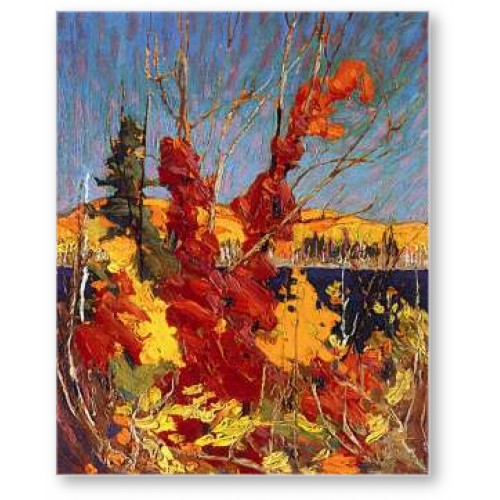
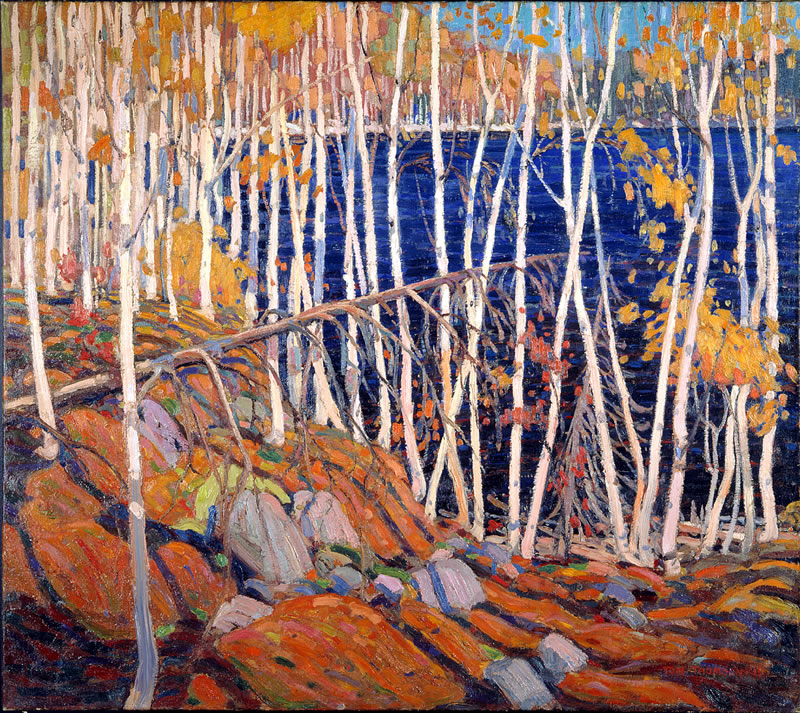
Once back in Atlanta as I leisurely browsed through the simply named volume, The Group of Seven and Tom Thomson, by David Silcox (Firefly Books 2001), I was impressed anew at this amazing collaboration of early twentieth-century artists who helped define a distinctively Canadian style of painting.  (See previous post on OCanadaBlog here.)  It also gave me a greater appreciation in particular for Tom Thomson, but for whose untimely death in 1917, the collective might well have been called the Group of Eight.   As one of the other members, Lawren Harris, noted in a narrative of the Group, “although the name of the group did not originate until after his death, Tom Thomson was, nevertheless, as vital to the movement, as much a part of its formation and development, as any other member.”

Tom Thomson, Autumn Foliage

Silcox’s beautifully compiled book is organized into thematic sections, initially around some broad categories, such as “Icons: Images of Canada,” “The First World War,” and “Cities, Towns and Villages,” and then by geographic regions, including “The East Coast,” “The St. Lawrence River and Quebec,” “Algonquin Park and Georgian Bay,” and “The Prairies, Rockies and West Coast,” among others.   This approach enables a wonderful comparison of each artist’s perspective on the same subjects and geography.  Preceding each section is  a brief narrative by the author that provides historical and cultural context that enriches the understanding of the individual Group members and their works.

Tom Thomson, In the Northland

Toronto’s Nuit Blanche

So-called Nuit Blanche arts festivals are held in many cities throughout the world, including in Montreal and Toronto.  Nuit Blanche, translates to “white night” and, more loosely, as “sleepless night” and has been typically associated with winter festivals taking place at night.  This year, Montreal held its Nuit Blanche in February, while Toronto held off until just a few days ago, with its own nighttime arts festival kicking off for twelve hours starting around twilight on October 2.   While I arrived in Toronto for a business trip a day too late to enjoy this first hand, the 2010 event marked the fifth anniversary for this all-nighter out on the town in Toronto.  An unsuspecting visitor to the city that evening might very well have observed the wondrous and grand spectacle of this arts fete and concluded that Torontonians had gone blissfully mad.

Jim Shaughnessy and Canadian Railroad Photography


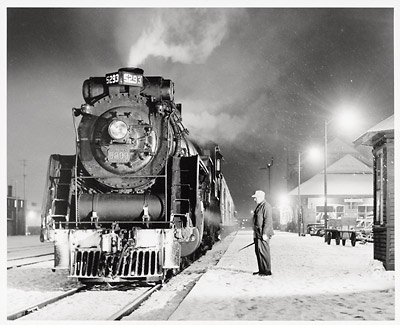
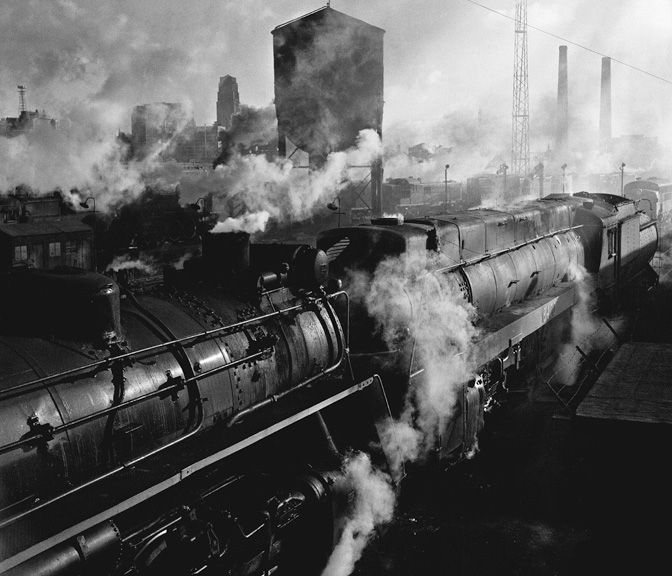
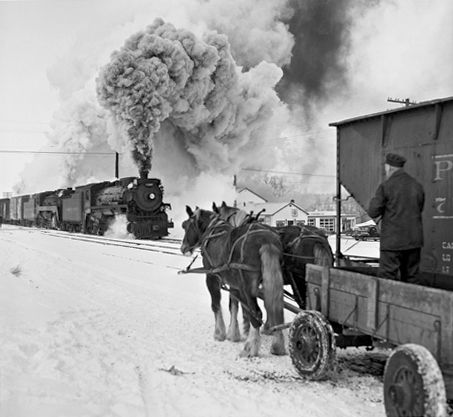
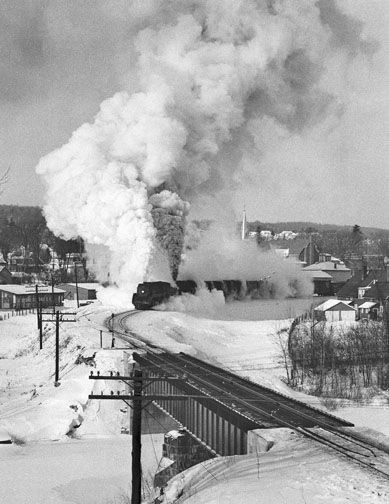
 (Canadian National, Sherbrooke, Quebec –1957)

Although during most of my childhood my family lived closed to various railway lines, I was born too late to regularly experience the thrill of hulking steam-powered trains pull into nearby stations.  On those rare occasions as a child that I encountered one of these mechanical monsters chugging through a rail crossing the feeling that gripped me was one of utter awe.  While the era of steam locomotives is now a fading memory, my wife recently surprised me with a gift of The Call of Trains:  Railroad Photography of Jim Shaughnessy (edited and with text by Jeff Brouws).

As a serious amateur photographer, I appreciate the artful composition of Shaughnessy’s exquisite black-and-white images.  He was a pioneer of railroad photography and his career extended over half a century, with many of the strongest images from his extensive work being from the 1950s and 1960s.  Because he lived most of his life in upstate New York, Shaughnessy was able easily to make periodic sojourns through Quebec, Ontario and other parts of Canada to capture amazing images of both the Canadian Pacific and Canadian National rail lines.   Underscoring this is that over a fifth of the images in the The Call of Trains are of Canadian railway scenes.   Below is a sampling of some of the wonderful images that may be found in the book.

      (Canadian Pacific, Spadina Avenue Facility, Toronto –1957)

 (Canadian Pacific, Cookshire, Quebec –1956)

(Canadian Pacific, Double-Headed Steam Locomotives and Freight Train, Lennoxville, Quebec –1954)

Link to The Call of Trains:  Railroad Photographs by Jim Shaughnessy on Publisher’s Website:   http://books.wwnorton.com/books/978-0-393-06592-3/

Yukon Art in Asheville


“Lake Tarfu, Yukon”

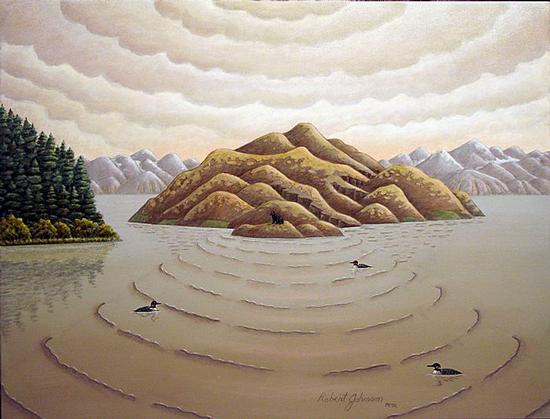
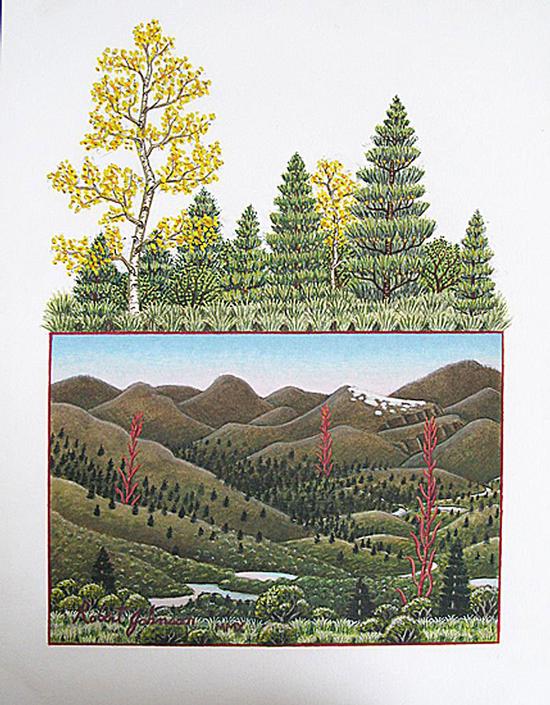
Several weeks ago my wife and I took a weekend trip to Asheville, NC, a small mountain city full of delightful shops, galleries and eateries.  Whenever I travel somewhere I am usually alert for a handful of things that are almost always on my personal radar, among them things with a connection to Canada.  So, as I was out on an early morning jog (great time for thinking, by the way) through the compact downtown area, I wondered what bits of Canadiana might surface on this trip.  Lo and behold, within the next few minutes a large painting of an exotic mountain scene caught my eye in the large display window of the Blue Spiral 1 Gallery.   I paused for a minute to consider further the bright image and at that point realized the painting was part of gallery’s then featured exhibition, called “The Golden Circle”, of works by North Carolina artist Robert Johnson documenting his travels through Southeast Alaska and the Yukon Territory.

Johnson compiled notes and sketches in his travel journals — pages from which were on display in the gallery — of the local fauna and flora in much the manner that a 19th-century amateur naturalist would have done.  From these he then prepared vivid acrylic and oil paintings of many of the notable sites he encountered on his journey through this remote territory in Canada’s far northwest.  His style immediately brought to mind the somewhat whimsical and primitive style of French Post-Impressionist artist Henri Rousseau.

“Bear Island, Lake Atlin, Yukon”

“North of Chilkat Pass, Yukon”

Link to Robert Johnson’s artwork at Blue Spiral 1:  http://www.bluespiral1.com/Master-HTML/artist/johnso_robert_10062/home.htm

Magnificent Travel Art of the Canadian Pacific Railway

Chartered in 1881 as a means of fulfilling the federal government’s commitment to British Columbia when it joined into the Canadian Confederation with the condition that a transport link from the east be established all the way to B.C., the Canadian Pacific Railway became a crucial link in forging a national identity that literally and figuratively united the east and west coasts of Canada.  As it grew, the CPR, as it was sometimes called, acquired additional rail corridors, steam ship lines, hotels and telegraph facilities.

Because of its many transport holdings, the Railway became associated more generally with travel of all sorts within the Canadian border, and, for many, even travel far beyond the country.  To promote its extensive travel offerings, the CPR commissioned a diverse array of what is now regarded as classic travel art, in the form of exquisitely illustrated posters, brochures and other advertising pieces.  A few examples are shown below (click on image for larger view).

Graphics courtesy of the Canadian Pacific Railway Archives.  Link:   http://www8.cpr.ca/cms/English/General+Public/Heritage/Graphic+Arts+Gallery/default.htm

Canada’s Colorful Coinage

As a teenager I avidly collected coins, and even today, although I’ve not been collecting for years, I still scan my change for the occasional odd coin that might have some collectible interest.  Some of the more prized items among the U.S. coins in my collection were my Peace dollars from the 1920s-30s, the Walking Liberty half dollars from about the same period and an early $5 Indian head “sunken design” gold piece.  All this coinage was notable for exquisite and unmistakable design artistry.  Yet, it is fair to say that U.S. coin designs of the past few decades are by and large staid and fairly boring.  The few exceptions to this are the commemorative state quarters, some of the recent design variations on the reverse of the Lincoln penny and the Jefferson nickel, and possibly the Sacagawea dollar.

So, while recently thumbing through a subscription to one of my Canadian magazines, my attention was drawn to an ad by the Royal Canadian Mint for a special issue silver dollar marking the centennial of the Canadian Navy, which in turn caused me to visit the Mint’s website (www.mint.ca).  I was aware of Canada’s 2004 issuance of the “red poppy” quarter, which was the world’s first general circulation coin using added color.  Those coins stand out and you can’t help but wonder when you examine one closely why the colorful flower doesn’t rub off.

Quarter Coin, with Red Poppy (2004)

Besides having some quirky nicknames for its coins (such as the “loonie” for its $1 coin and the “toonie” for its $2 coin), it turns out that Canada has pioneered color coin technology in a number of its general circulation coins, as well as with quite a few mintages of other coins that are specially issued for collectors.  In addition, there are coins with mixed metals, with embedded crystals and featuring holograms.  This is pretty amazing stuff!  (Canadians, do you know your Mint is doing this?)

Simply browsing the Mint’s website reveals numerous outstanding designs with themes touching upon all aspects of Canadian society.  Coins routinely serve as constant reminders of significant cultural touchstones and the numerous offerings of the Mint attest to this function.  There are too many coins on the Mint’s site that elicit my appreciation.  What follows are just a few of  these:

$20 Silver Coin, with  Blue Snowflake Crystals (2009) 

$20 Silver Coin, with Colored Maple Leaf and Crystal Raindrop (2009)

$20 Silver Coin, with Colored Lily and Crystals (2010)

$3 Silver Coin, Return of the Tyee Theme, with Pink and Yellow Gold Highlights (2010)

$1 Silver Proof Coin, The Sun Theme (2010)

Silver Kilo Coin, Antique Finish, The Eagle Theme (2010)
The Group of Seven’s Landscape Explosion

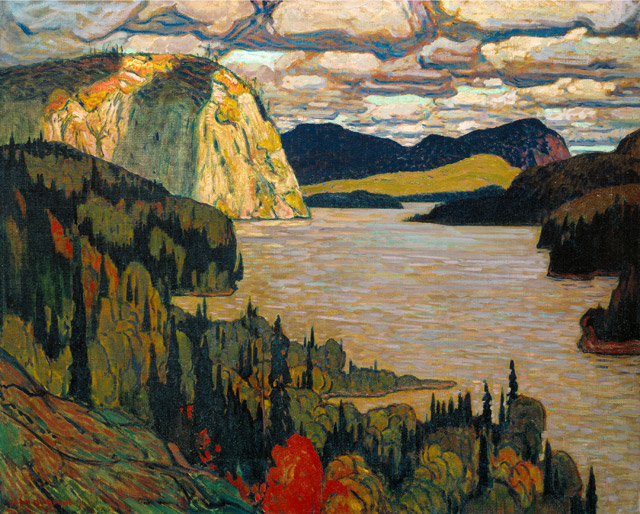
J.E.H. MacDonald, The Solemn Land

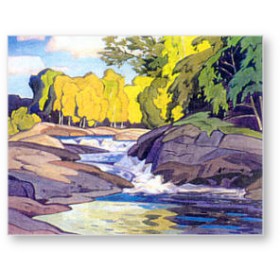
While reading a story in the latest volume of The Journey Prize Stories (more on that collection in a later post) I came across this passing reference to the Group of Seven:  “Straight ahead a group of smallish islands.  Like the Group of Seven but realer and more sad.”  The narrator’s incidental reminder of this ground-breaking group of Canadian artists, who first rose to prominence in the 1920s (although several painted well after this period), prompted me to refresh my knowledge of an amazing band of painters who are not well-known to many people here in the U.S., but who collectively serve as a cultural touchstone for Canadians, as indicated by the above quote from the story I was reading.
Lawren Harris, Clouds, Lake Superior

The members of the group initially consisted of Franklin Carmichael, Lawren Harris, A.Y. Jackson,  Frank Johnston, Arthur Lismer, J.E.H. MacDonald and Frederick Varley.  Frank Johnston left the group in 1926 and A.J. Casson was invited to take his place.  In addition, Tom Thomson and Emily Carr are also closely associated with the principal seven, and Thomson, in particular, was very influential even though his passing in 1917 preceded the group’s most prolific period.  It’s fair to say that their collective focus on the Canadian landscape helped define in the popular imagination the majesty of Canada’s vast natural treasures.

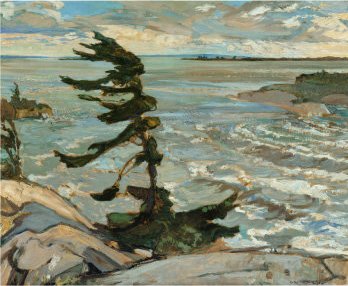
Frederick Varley, Stormy Weather, Georgian Bay

Their work reminds me of the more loosely defined California School of American landscapists, whose many paintings of the American West during the first half of the Twentieth Century exhibit a subject matter and color palette remarkably similar to that of the Group of Seven.  Both groups were obviously borrowing from and re-interpreting the approaches developed by the French Impressionists several decades earlier, and the Group of Seven evolved to adopt the vivid colors of Post-Impressionism and the simplified forms of abstraction of Art Nouveau.  While other points of commonality can be found between the work of these artists and others here in the States (for instance, Lawren Harris’s spare abstracted landscapes bear a striking resemblance to some of Georgia O’Keeffe’s pieces), even if one does not recognize these connections there is much to appreciate in the Group’s representations of Canada’s diverse geography.
A.J. Casson, Rapids

As a whole the Group of Seven were prolific and their paintings and other works are held in many Canadian and other museums and collections.  There are also several useful websites devoted to the Group with rich resources available for further exploration.  Most notably, perhaps, is the site for Ontario’s McMichael Canadian Art Collection / Gallery (http://www.mcmichael.com/collection/seven/index.cfm), which houses one of the largest collections of the Group’s works.  The CBC has a wonderful set of digital archives (http://archives.cbc.ca/arts_entertainment/visual_arts/topics/754/) featuring video and audio on various aspects of the work of the Group, including rare interviews and footage of some of the artists themselves.

Atlantan Named Curator of Quebec’s Manif D’Art 5; Katherine Taylor and Sarah Emerson Selected to Show

This year marks the 5th Manif D’Art Biennale (actually the Manifestation internationale d’art de Quebec), a contemporary arts convocation hosted in Quebec City, Quebec.  The Manif’s program consists of a series of exhibitions throughout May and into June throughout Quebec City of major national and international artists.  That is a splendid time of the year to be in Quebec City (well, pretty much anytime is a good time of the year to be there).  More on the Manif can be found at this link:  http://manifdart.org/en.

A pleasant surprise is seeing several Atlanta connections to this major arts event.  The first is the appointment of Sylvie Fortin, the Editor-in-Chief of Atlanta-based Art Papers magazine, as the curator for this biennale.  This seems to me a brilliant choice, given the prominence of Art Papers and the direction that Fortin has taken it during her tenure over the past five years or so.

In the late 1990s, I did a good bit of art-related writing for a wonderfully quirky local publication called bluemilk.  This was partly as a sort of hobby and outlet for my creative writing interests and also part of an effort to educate myself better about the artistic process at a time when I was teaching myself to paint (but only at best as a so-called “Sunday painter”).  The dozen or so of us bluemilk-ers had a great deal of enthusiasm, creativity and chutzpah, but we were all candid about the fact that, while we had respectable foundations in art history and art technique, none of us had a strong grounding in the deeper dialogues and debates among the cognoscenti of the contemporary arts scene.  We mainly knew what we liked and went with that.  But what we also knew was that the folks over at Art Papers were definitely in the know about the underpinnings driving the direction of contemporary arts and we respected them greatly for that knowledge.  So, Fortin’s appointment as curator validates that respect.

Fortin will be curating the Manif with the theme of “Catastrophe?  Quelle Catastrophe!”   The initial group of artists announced for the Manif hale from Quebec, Toronto, Vancouver, London, Copenhagen, New York, Miami and Atlanta, among other places.  The two announced Atlanta artists are Katherine Taylor, noted for her haunting painted images of decay and devastation (represented by Marcia Wood Gallery: http://www.marciawoodgallery.com/artist/taylor_katherine/intro.html), and Sarah Emerson, remarkable for her colorful and whimsical abstracted landscapes (represented by Whitespace Gallery: http://www.whitespace814.com/artist_emerson.html).